
A hernia occurs when an internal part of the body pushes through a weakness in the surrounding muscle or tissue wall. Hernias are common and, while not always dangerous, usually require repair to prevent complications.
Common types
- Inguinal hernia — the most common type, in the groin.
- Umbilical hernia — at the belly button.
- Incisional hernia — through a previous surgical scar.
- Femoral & other hernias.
Symptoms
A visible bulge that may appear when standing or straining and disappear when lying down. You may feel discomfort, aching or pressure, especially when lifting, coughing or standing for long periods. Seek urgent care if you experience severe pain, nausea or vomiting — these can signal a strangulated hernia.
Treatment
Prof. Mittal repairs hernias using robotic and laparoscopic (keyhole) techniques, reinforcing the muscle wall with a mesh. These minimally invasive approaches use small incisions, which can mean less pain and a quicker return to normal activity.
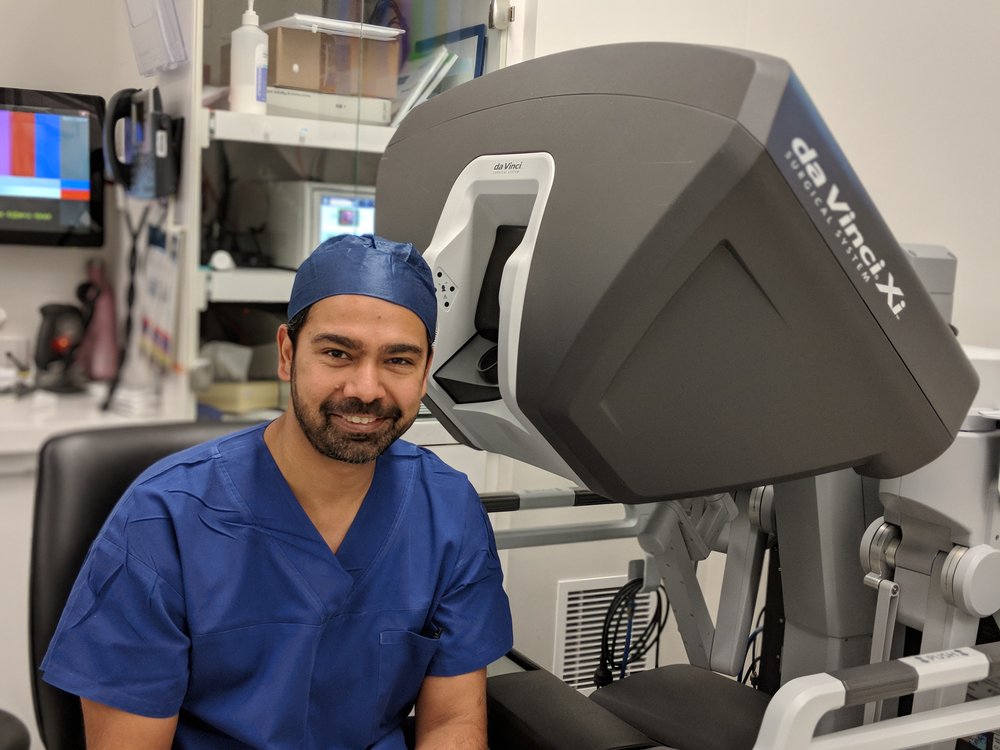
Robotic and keyhole repair — what it involves
Repair is performed under a general anaesthetic and usually takes about 30 minutes (under an hour if both sides are repaired). Using keyhole (laparoscopic or robotic) technique, the hernia is pushed back and the muscle wall is reinforced with mesh through a few small incisions. Local anaesthetic injections, and sometimes antibiotics, are given to help with pain and reduce infection risk. Keyhole repair generally means less pain and a faster return to normal activity than open surgery.
For small, painless hernias, watchful waiting or a truss can be appropriate — but surgery is the only definitive fix. Untreated hernias enlarge over time and risk strangulation, which requires a larger, urgent operation.
Recovery — what to expect
Most hernia repairs are performed as a day procedure or with one night in hospital. If you stay overnight, discharge is usually the next morning.
| Timeframe | What you can do |
|---|---|
| Day 1 | Walking regularly — encouraged from day one. Light daily activities as tolerated. |
| Week 1 | Most people return to normal daily activities and desk work. |
| Weeks 2–3 | Build up activity. Avoid sport and strenuous exercise for 3 weeks. |
| Weeks 4–6 | Continue avoiding heavy lifting and strenuous activity for 4–6 weeks — this is crucial to let the repair heal and prevent recurrence. |
Driving — do not drive until you are no longer taking strong pain medication and can perform an emergency stop without pain. Discuss this at your follow-up.
Work — desk-based work is usually possible within 1–2 weeks; manual work involving heavy lifting needs 4–6 weeks. Clearance letters for your employer can be provided.
Pain management — take pain relief as prescribed before you leave hospital; Panadol or Panadeine Forte are usually sufficient. Do not take aspirin, blood-thinning medications (clopidogrel, apixaban, warfarin) or anti-inflammatories (Nurofen, Voltaren, Mobic) for 7 days before or after surgery unless Prof. Mittal specifically instructs otherwise.
Wound care — you may shower; wash gently with warm water and mild soap, and pat the wound dry (do not rub). Keep the wounds clean and dry, avoid baths, pools and hot tubs until fully healed, and do not apply lotions or powders near the incisions.
Follow-up — a post-operative review with Prof. Mittal 4–6 weeks after surgery. Contact the rooms on discharge to book.
Long-term outlook — most people make a full recovery. The hernia can recur in fewer than 3 in 100 repairs; risk depends on hernia size, muscle strength and other health factors.